
Why Vertical Axis Wind Turbines Are the Future of Wind Energy
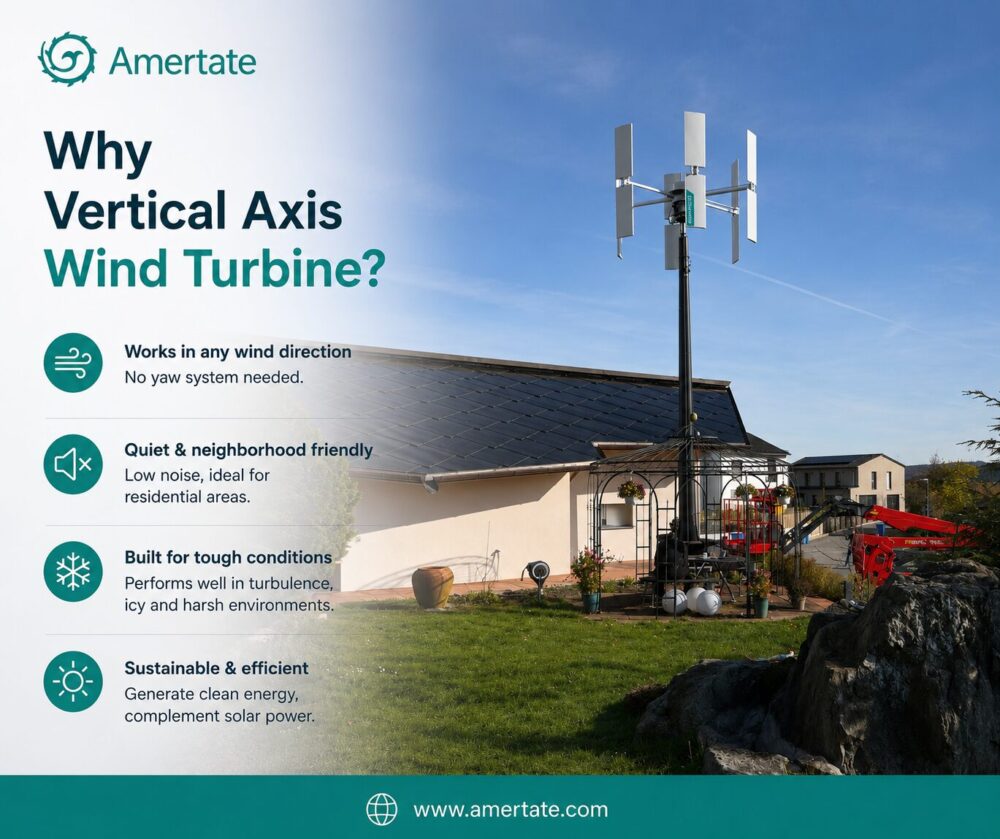
Why Vertical Axis Wind Turbines Are the Future of Wind Energy
Wind power used to mean one image: giant horizontal axis turbines high above open fields. But a quieter shift is underway. The vertical axis wind turbine (VAWT) is emerging as the preferred choice for homes, farms, and businesses that want reliable, decentralized energy without the noise, size, or complexity of traditional turbines.
What Makes a Vertical Axis Wind Turbine (VAWT) Different?
Unlike conventional horizontal-axis wind turbines (HAWTs), a Vertical Axis Wind Turbine (VAWT) rotates around a vertical shaft rather than a horizontal one. This fundamental design difference—combined with Amertate’s patented self-adaptive blade technology—enables a new generation of small wind turbines optimized for decentralized, on-site renewable energy production.
Key advantages of modern VAWT technology include:
- Omnidirectional Wind Capture – A VAWT efficiently accepts wind from any direction without requiring a yaw mechanism, reducing mechanical complexity while maximizing operating time under continuously changing wind conditions.
- Ultra-Low Noise Operation – Advanced aerodynamic design and lower rotational speeds significantly reduce noise emissions, making modern VAWTs suitable for residential areas, commercial buildings, farms, and other noise-sensitive environments.
- Compact and Space-Efficient Design – The vertical architecture requires a smaller installation footprint than traditional turbines, making it well suited for urban environments, industrial facilities, and distributed energy projects where space is limited.
- Simplified Maintenance – Major drivetrain and electrical components are installed near ground level, allowing faster, safer, and more cost-effective servicing without large cranes or complex maintenance procedures.
- Enhanced Safety and Reliability – The lower center of gravity, controlled blade speeds, and simplified mechanical structure contribute to reliable operation even in challenging weather conditions, while reducing mechanical wear over the turbine’s lifetime.
By combining these inherent VAWT advantages with patented self-adaptive blade technology, Amertate delivers a wind turbine designed for higher annual operating time, quiet performance, and affordable decentralized clean energy in both rural and urban applications.
The Low-Wind and harsh-Climate Advantage
One of the biggest barriers to small-scale wind adoption has always been unreliable wind resources. However, Amertate’s VAWTs now feature ultra-low start-up wind speeds, generating electricity in breezes as light as 1.5 m/s — well below the threshold that stalls most conventional systems. This matters enormously in a country like Finland, where wind is often gusty and unpredictable rather than constant.
Cold-climate resilience is equally important. In Nordic markets, ice accumulation can cripple blade performance on horizontal turbines. Drag-based VAWT designs are far less sensitive to icing, giving them a real edge for arctic and winter-resilient wind power — a growing search theme as more Nordic and Baltic buyers look for turbines built for their climate, not adapted from a warm-weather design.
Silent, Storm-Proof, and Built for Everyday Sites
Search interest around “silent wind turbine” and “quiet residential wind turbine” has grown alongside noise complaints tied to older turbine models. Amertate turbines are specifically engineered with low-RPM designs that produce little to no perceptible noise even a short distance away — opening the door to installations near homes, offices, ports, and farms where noise ordinances or nearby neighbors previously ruled wind out. Our turbines also include intelligent safety modes that adjust blade angles during storms, allowing continuous power generation instead of a full shutdown — a meaningful differentiator over legacy systems that go offline in high wind.
Off-Grid, Distributed, and Hybrid-Ready
Global research consistently points to rising demand for off-grid wind energy and distributed wind power , especially where grid infrastructure is weak, expensive to extend, or entirely absent. VAWTs pair naturally with wind-solar hybrid systems , since wind often peaks at night and in winter — precisely when solar output drops. For agriculture, telecom towers, islands, EV charging stations, and remote microgrids, this complementary generation profile is becoming a core selling point.
The Bottom Line
As distributed, resilient, and low-noise energy generation becomes a priority for homeowners and businesses alike, vertical axis wind turbines are no longer a niche alternative — they’re a practical answer to wind energy’s biggest historical limitations: noise, unreliable low-wind performance, and vulnerability to harsh winters.
At Amertate, this is exactly the gap we build for: turbines designed around real Nordic wind conditions, not adapted from them. If you’re evaluating small-scale wind for a home, farm, or off-grid site, get in touch — we’re happy to walk through which setup fits your location.
